

It must be a fear rooted in our collective primal psyche — of sitting on the toilet and being attacked from beneath by a rat or a snake or some other creature that has crawled its way up the pipes and through the u-bend, striking when you’re most vulnerable. It’s a largely irrational fear, but that doesn’t mean it’s wholly unfounded.
That’s not the focus of The Host, of course, but one can extrapolate that being a potential eventual outcome. It is suggested by the shot of the Flukeman hiding in the waste of a porta potty. It is threatened by the closing shot of ol’ Flukey lingering in the depths of the city sewage system. It is implied that those attacked sanitization workers are merely the first wave of victims — and that any one of us could eventually find ourselves the unwitting victim of the monstrous parasitic creature.
And honestly, what could be creepier than the thought that such disturbing horrors could befall any of us while taking care of one of our most basic everyday bodily functions? It’s a thought so off-putting you’ll be too scared even to shit yourself.
The Host takes this most unsettling of concerns and runs with it, creating one of The X-Files’ most iconic villains. The episode’s origins, however, demonstrate the show’s fantastic knack of taking something that exists in the real world, liberally twisting it, and taking it to the extreme to make the basis of a great horror story. Here, the inspiration was Carter’s disgusting experience with his pet dog getting worms. Multiplied to the power of X and of course you get a humanoid flukeworm villain.
As Scully points out, “Believe it or not, something like 40 million people are infected [with such parasitic worms] worldwide.” Yuck.
Indeed, much of the episode’s physiological grossness is based in real-world science. Flukeman’s bite mark on the initial sanitization worker is modeled on the wound inflicted by actual flatworms’ sucker-like mouths, only much, much larger. The fact that Flukeman transmits its larvae through bites, using its victims as hosts to incubate its young, only adds to the horror.
One would like to imagine that some of the other vivid imagery associated with the parasitosis is exaggerated for TV — such as the flukeworm bursting out of a body mid-autopsy or being coughed up by a host while taking a shower — but I’m not about to research it and verify that what the show portrays is legit. So, let’s just assume it’s exaggerated, shall we?
On that shower scene: apparently the producers had to push back hard to get Fox to agree to air the scene as it did. Described as one of the grossest moments of television ever broadcast at the time, it pushed the envelope for what was permissible in primetime.
Elsewhere the show adheres to strict standards and practices, yet still manages to convey a sense of bloody violence: when the Flukeman is chopped in half, you don’t see any blood or guts, yet the expression the creature makes and the noise it emits powerfully conveys the painful attack so sufficiently that you recoil, even though it is a monster getting its just deserts.
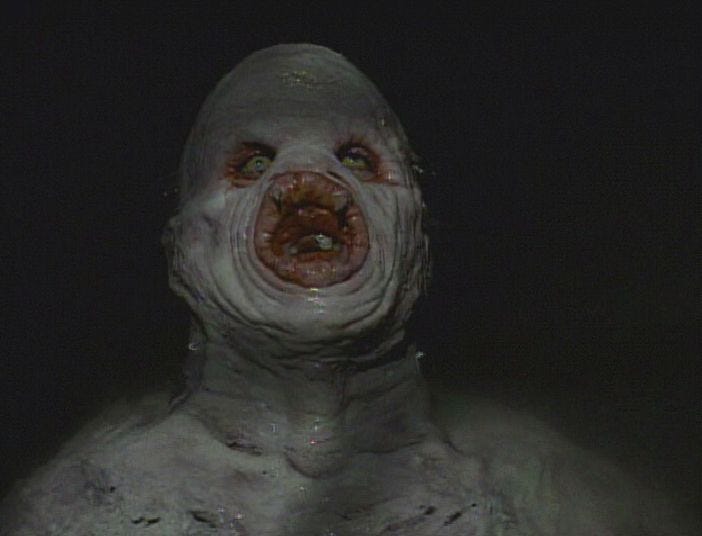
And what a nasty-looking cryptid the Flukeman is! When we get our first good glimpse of the monstrosity, trapped in a glass tube at the sewage works, he is all wrinkly prune skin, inhuman eyes, and a large tooth-filled maw — a disgusting mutant that is sure to leave a bad taste in your mouth that all the toothpaste and chewing gum in the world can’t get rid of.

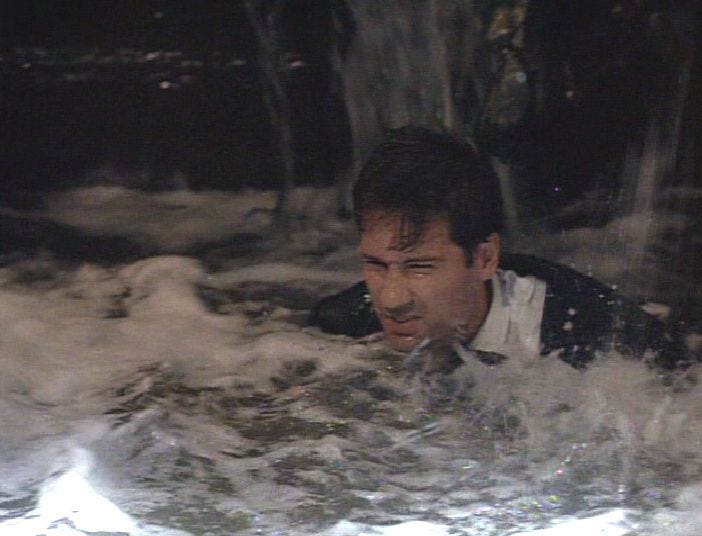
The Host is dripping in a sense of stomach-churning nausea. It does take place in the world of industrial-scale human waste, after all. Credit is due in no small part to the cast for convincingly selling their repulsed reactions to the terrible smells they encounter — particularly in the scene where Mulder and the Sewage Foreman explore the water-logged tunnels at the episode’s climax. (It’s also noteworthy that, just one season prior, Mulder was vocally worried about getting a little bit of bile off his fingers without betraying his cool exterior, but here he’s suffering the indignity of polluted drainage dripping on his shoulders — and that’s before he takes a spill in the agua most foul.)
Regardless, the old industrial aesthetic of this setting, not to mention the sewers themselves, are perfect for the moody, shadowy locations The X-Files was known for.
So too, the Flukeman is a perfect X-Files baddie. He’s deadly, but he’s not human, so how exactly do you resolve this case upon his capture? He can’t be prosecuted. Is he disappeared into a laboratory and experimented on? Is he simply destroyed as if he were a rabid animal? The Host confronts this dilemma but never finds a solution.
As with any great episode of the show, much is left unresolved. The wrap up theorizes on the origins of the Flukeman — a mutation caused by radioactive sewage from Chernobyl, making him something of an incestuous offspring of Godzilla and Creature from the Black Lagoon — but Mulder is quick to point out that “they say three species disappear off the planet everyday… you wonder how many new ones are being created.”
Ultimately, life persists. And so does the Flukeman (or at least one of his potentially hundreds of offspring) who is alive and well in the episode’s final shot. Still out there. Still swimming. Still potentially poised to slither up your sewer pipe and attack you when you least expect it.
This essay is an extract from my book Spooky: The Horror of The X-Files now available to buy on Amazon and Kobo.