

After an entire team of researchers at a remote Alsakan base are killed in a mass murder-suicide, Mulder and Scully are sent to investigate along with a team of other scientists to determine what on earth happened there. But once they arrive in the middle of nowhere, they realize too late that they’ve walked right into a trap: there is an ancient extraterrestrial parasite on the loose that hijacks its host to kill all others. Not knowing who to trust, the group quickly turns on each other in a deadly fit of suspicious paranoia from which there is little chance of escape — or survival.

Ice is John Carpenter’s The Thing on a TV budget. Or, perhaps more pedantically, it was inspired by the same source material as that movie (John W. Campbell’s novella, Who Goes There?). But as far as your average modern horror fan is concerned, Ice is a masterfully done ripoff of The Thing on a TV budget.
Yes, the similarities between the two are difficult to overlook: both are set at isolated scientific stations in the (Ant)Arctic, involve an undetectable infection, and deal with increasing paranoia and mistrust among those stranded together in close quarters as an alien organism covertly “possesses” individuals — making them a deadly threat to the other non-infected characters.
But whereas The Thing is a gory special-effects laden cinematic thriller, The X-Files’ version had the constraints of a 90’s TV budget and production schedule, which meant the central idea translated into a much more of a psychological thriller than its action-movie counterpart.
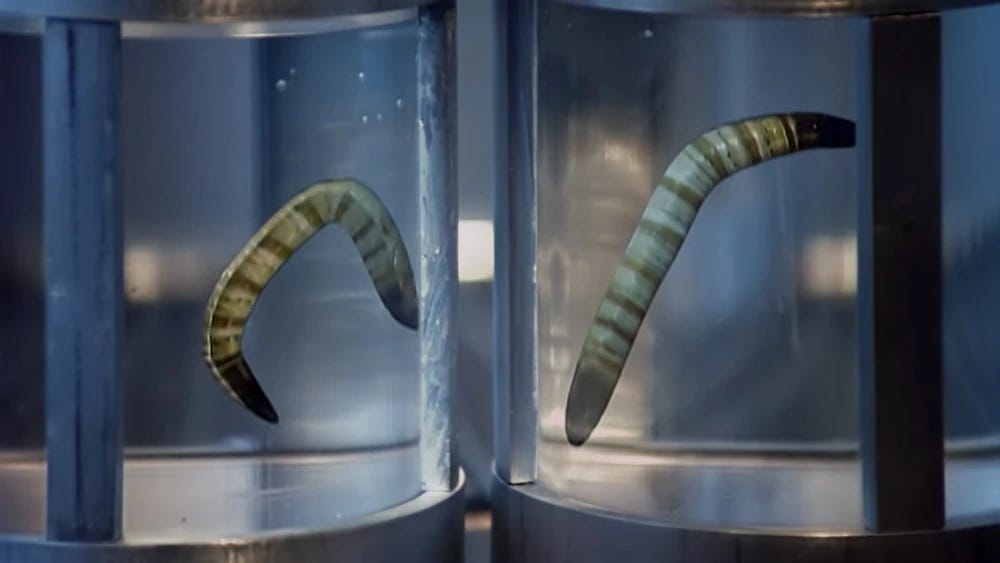
The episode begins with a video transmission from the lone survivor of a crew based at a remote Alaskan research station who keeps repeating the same phrase over and over again: “We are not who we are… We are not who we are…” In retrospect, it was a heroic feat on his part — his remaining humanity momentarily triumphing over the murderous brain worm to send a warning to anyone who might otherwise venture to the base to figure out what went wrong. What a pity it wasn’t heeded!
Soon enough, Mulder and Scully are stranded at that very same base with three other scientists and a helicopter pilot. But no sooner than they arrive, so the pilot is bitten by a seemingly rabid dog left behind by the first (now dead) team. The dog was infected, its bite infected the pilot, and everyone’s favorite redhead quickly figures out that they’re dealing with a transmissible parasite that turns its host homicidal.
And so begins a highly taut pressure cooker of a situation with this small handful of characters stranded together in the last frontier, not at all sure whether they can trust each other. If any one of them are infected, then it could spell death for the others. This is The X-Files at its peak: Ice is a horror chamber piece that fully embraces the show’s 70s paranoia inspirations via its source material’s red scare subtext.
Despite the illogic, divisions amongst the group fracture along lines of familiarity. Mulder and Scully naturally have each other’s backs, as do Drs. Hodge and DaSilva. But there’s no tangible reason for any of them to divide and team up in such a way — because there’s literally no way for any of them to know who amongst their number is actually uninfected or not. It’s a complete guessing game; even that person you believe you can ordinarily trust more than anyone else in the world might not be who they appear to be.
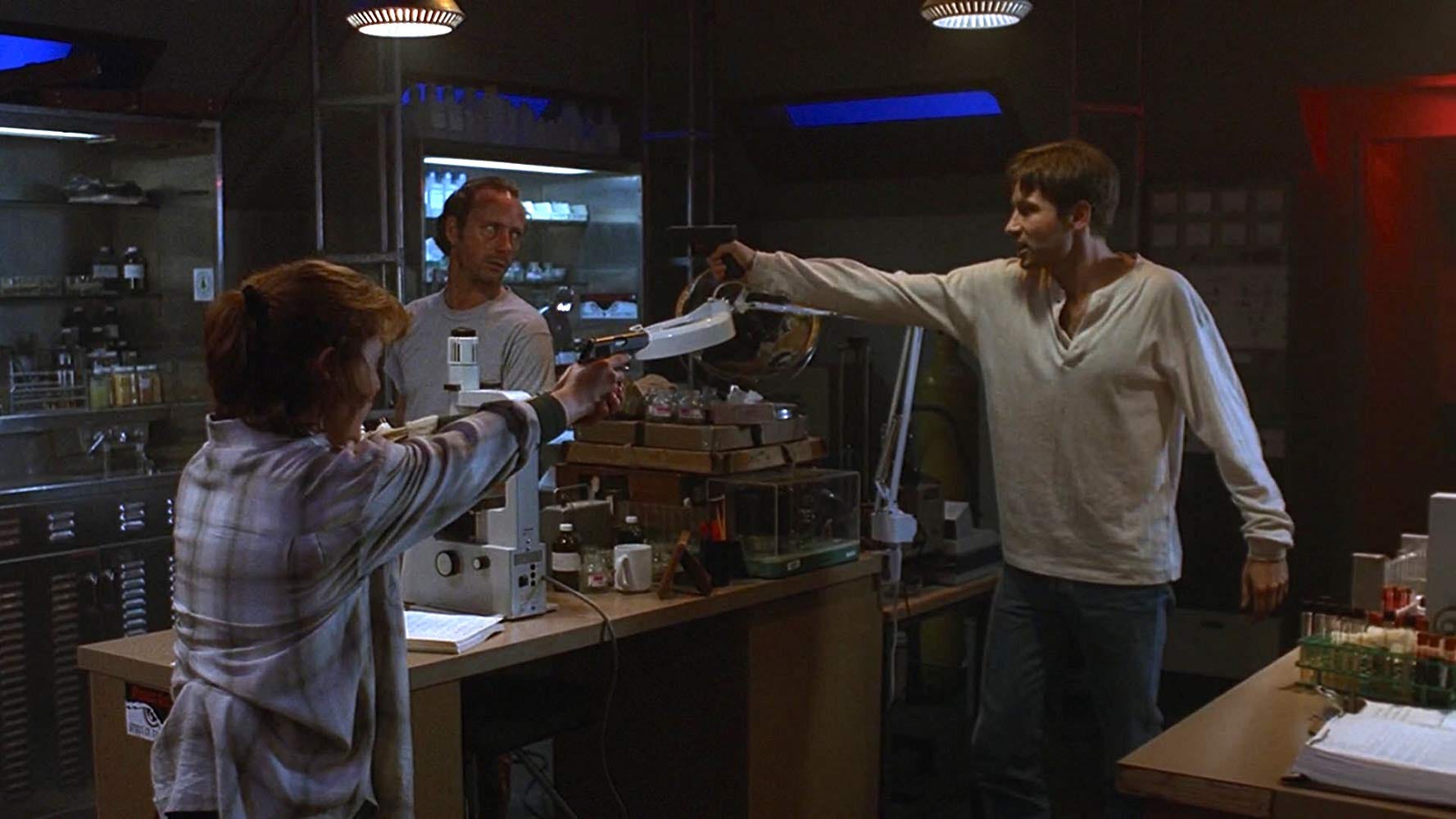
And let’s not lose sight of what’s ultimately at risk here: it’s not just that the infected unhindered will kill everyone else. To be infected by the parasite is to lose your very self. First your mind, but ultimately your life. When the pilot, Bear, realizes that he is infected, he desperately wants to flee the ice station and get back to civilization. Part of that is surely the parasite’s ambition to spread its contagion to as large a populace as possible, but it’s also significantly driven by Bear’s very real and very human fear for his own mortality.
Ice is also a great example of how The X-Files uses science to both legitimatize and propagate fear. In determining the stakes of the situation they’ve blundered into, Scully and the other scientists examine the parasitic organism to learn about the grave threat that it poses. They hypothesize, they learn new information, and their understanding evolves.
Science also poses a probable cure: the parasites are hermaphroditic; they don’t need another to reproduce. Rather, they are antagonistic to each other — and would kill each other rather than have to share a host. Experimenting on the dog they know for sure is infected, they discover that introducing a parasite into an already-infected organism cures it. Bingo, the dog is back to normal.
The problem is that the majority believe (but don’t know for certain) that Mulder is infected. And so, when they try to cure him by purposefully inoculate him with a parasite, they don’t really know whether they are actually saving him — or condemning him (and, by extension, themselves).
Ice is an extremely well executed hour of television that served as an early high bar for what the show could accomplish at it’s very best. It’s a chilling examination of human nature under duress, that employs relentless tension to ratchet up the terror, all while touching on themes of fear, trust, and identity.
It isn’t just a great example of a scary X-Files episode, it also helped solidify the show’s reputation as an intelligent horror series, specifically by leaning into both these thematic explorations and the underpinning science that allows our heroes to make sense of this most unnatural horror they are confronted with.