

The Amityville Horror is one of those prolific beacons of the genre, a quintessential title that forms a sort of unholy trinity of 20th century horror alongside Rosemary’s Baby and The Exorcist.
Needless to say, I came to Amityville with high expectations, but after first watching the film, I was unimpressed.
I’m just going to say it: The Amityville Horror (Stuart Rosenberg, 1979) sucks. It is a dull, boring, not-at-all scary film.
Fortunately, the book on which its based is none of those things.
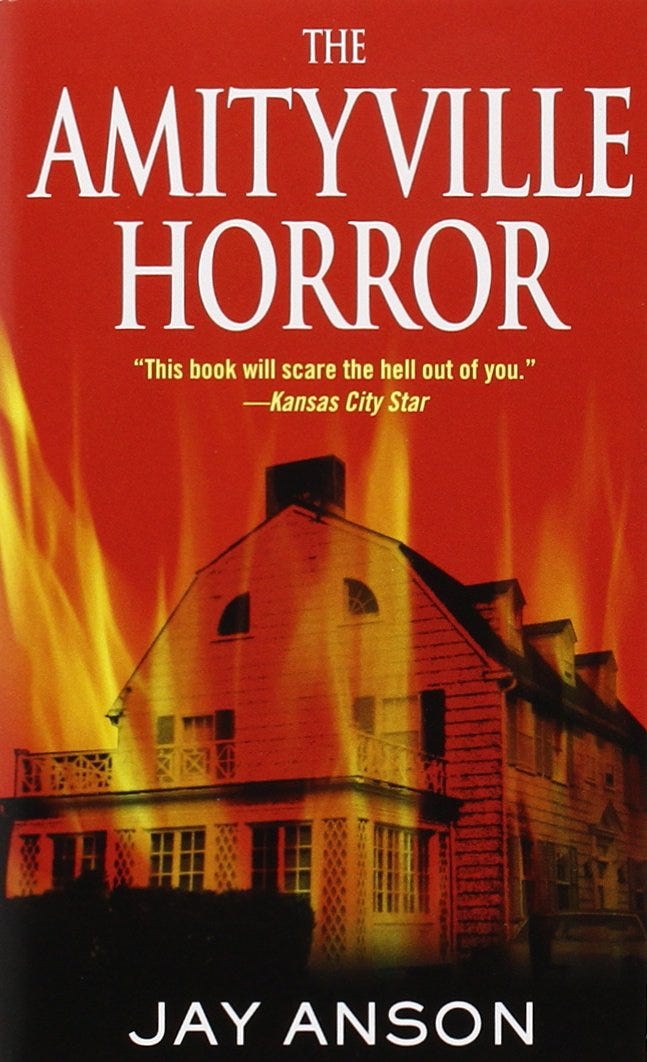
I really enjoyed The Amityville Horror. Although it follows a fairly standard blueprint for a haunted house story, it does a great job of slowly-but-surely cranking up the tension and escalating the horrors.
(Yes, it’s a well-worn trope that just as soon as the protagonists realize they need to flee, they are unable to do so, but it still gave me some perverse pleasure when the book hit that recognizable note.
Is The Amityville Horror derivative of countless other horror house narratives, or does it deserve to be considered an originator of the modern form? Feel free to discuss in the comments.)
Here’s the plot in a nutshell: a young family are looking for their dream home on a budget. They find the perfect property, only to learn that an infamous murder occurred there in the recent past. Ever since a young man killed his parents and siblings in those very rooms, the house has stood empty — which is why it’s listed for such a good price.
George and Kathy Lutz don’t care. They move right on in.
Very soon, they wish they hadn’t.
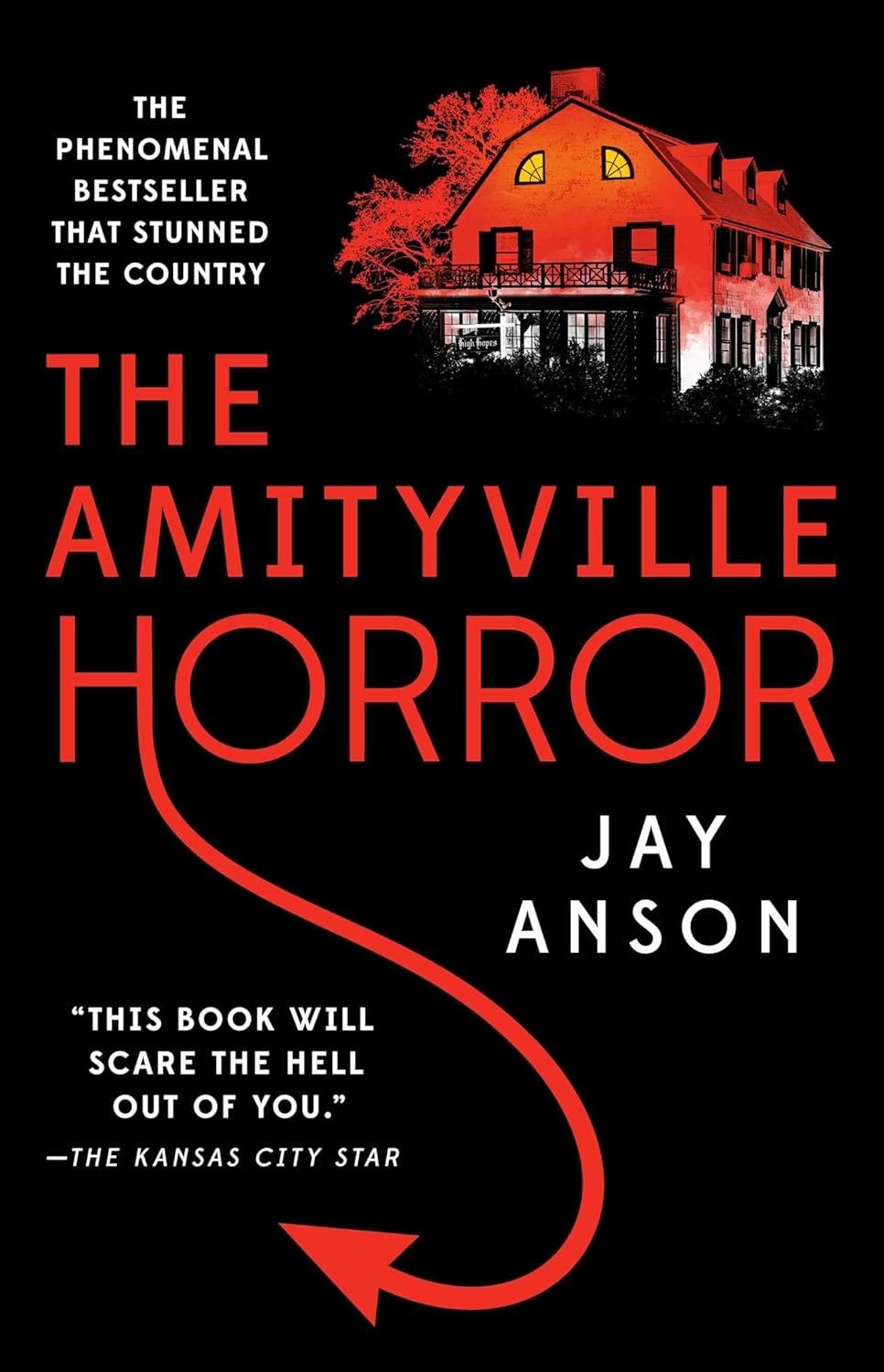
Almost immediately, strange occurrences begin to trouble the family. It is inexplicably cold throughout the house, a swarm of flies materialize in one particular room, objects move or go missing, and their little girl discovers a new imaginary friend who has the face of a pig.
Creepy shit!
Part of what makes the book so effective, even half a century later, is the relatable mundanity of the situation: George and Kathy are deeply disturbed by living in the house, it alters their psyches, spooks them, and yet they still have to continue with the tasks of running a household and earning a living. Yes, the family is being terrorized on a nightly basis, but life goes on and bills still need to be paid.
Anson tells the story in a mostly clinical and detached fashion, keeping us at arm’s length from the inner minds of the characters, but it is a cooly effective writing style for this particular spooky story, almost like reading a police report detailing the events of some unfathomable horror.
Despite this largely unemotional approach, it does provoke fear in the reader. There’s no attempt to explain or legitimize the things that are happening. All we know, all the characters know, is that something scary is going on — and not understanding of exactly what is not only feels authentic but adds to the frightfulness of it all.
Of course, this almost journalistic approach is only partially by design, as The Amityville Horror isn’t entirely fictional.
According to Wikipedia, the murders that occurred in the house were real. George and Kathy Lutz are real people, really did buy the house and then fled it less than a month later, leaving all their possessions behind. Naturally, there are various disputes over accuracy, but the consensus supports the book’s marketing that The Amityville Horror is indeed based on a true story.
I’m sure there are greater conversations that could be had (and surely have been in other corners of the internet) about the truthiness of the book, but my interest is only in whether or not it’s a good horror novel.
It is.
The Amityville Horror is a decent ghost story that is well told. It’s a stark, spare, and scary horror novel — worthy of the pedestal upon which it is placed, and far, far superior to the lackluster film it inspired.
As an Amazon Associate I earn from qualifying purchases. You can support Horror Harwood by buying The Amityville Horror on Amazon here. Thank you :)
I had the the edition you put up, and I remember constantly flipping the cover while I read, because it was as creepy as the words. The book is far easier to buy than any of the adaptations and sequels. The OG film has a certain spark I'll always love, largely Lalo Schifrin's mesmerizing score.