

After the untimely death of their young son, Magos and Joseph are utterly distraught. But whereas her husband falls into a catatonic funk of tears and grief, Magos takes an entirely different tact: she carves a piece of their son’s lung out of her body and keeps it as a souvenir of the innocent boy she loved so dearly and lost far too soon.
Santiago was a sickly child, but he was loved greatly by both of his parents and indeed his extended family. He was also, evidently, the glue that held his parents’ marriage together. When Magos leaves New York to return home to Mexico City (where the family previously lived together), Joseph does not follow. Instead, Magos goes to stay with her mother, in an old house that, while it appears immaculately well-kept, is actually crumbling all around them. The metaphor couldn’t be more blatant.
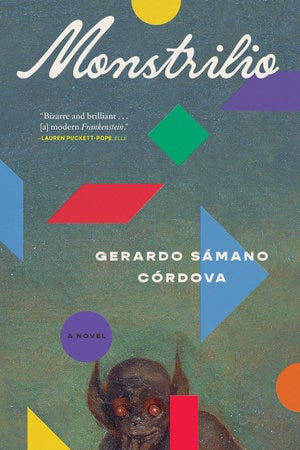
Alone, depressed, yet still incapable of properly mourning Santiago, Magos discovers a folk tale about a woman who fed a deceased loved one’s heart until it regenerated into a new and different person. The story is intended as a warning, but Magos just hears opportunity. She feeds Santiago’s lung. Soon it becomes animate. Not too long later, it evolves into a small, very sneaky, and violently bloodthirsty creature.
The lung monster attacks Magos’ mother’s dog. It attacks Magos’ mother. It kills and eats various neighborhood pets.
Magos and Joseph are reunited, but it seems that any hope of their marriage surviving long term is a pipe dream. The lung monster grows into a young childlike monster, hairy and dexterous with a penchant for fresh flesh, but a welcome substitute for the departed Santiago nonetheless.
They name this monster child Monstrilio. For a while, the family rekindles their former happiness, but with the added wrinkle of preventing Monstrilio from attacking and eating any animals or humans that might cross his path and whet his appetite. Fortunately, Magos and Joseph have the support of their family and friends to support them in raising and protecting Monstrilio — as well as discouraging his true instincts.
As time goes on and the book progresses, it passes between different POV characters: initially Magos, then Lena (Magos’ childhood friend, now a surgeon, who has harbored a lifelong crush on Magos), then Joseph (after he has returned to New York to live, his marriage to Magos now well and truly a relic of the past), then finally Monstrilio himself — now a young man going, simply, by M.
It’s a deftly told tale and the four acts told through different perspectives allows the story to be revealed efficiently, diligently, and with ever-expanding depth. (As a parent myself, I did find Monstrilio to be rather poignant in its portrayal of passing time with regards to growing children — especially as my eldest nears the end of his high school career and is starting to look forward into the abyss of “what next?”. But I digress.)
There is violence. There is bloodshed. There is a literal monster. But Monstrilio is not a mere scary story, rather it utilizes the traits of the horror genre to spin a narrative that is very much about the human condition. As Monstrilio ages into M, he grows more and more humanlike — becoming a better-than-anticipated surrogate for Santiago. Just a lot hairier and far more bloodthirsty.
Sámano Córdova’s literary prose is simple, straightforward, and oh so easy to consume. Monstrilio is a breezy read — and yet, for such an undemanding novel, it does some exceptionally heavy lifting. It lingers in your mind for days afterwards, leaving you to contemplate the various themes and thoughts it evokes but never quite deals with directly.
How Magos and Joseph try to suppress M’s monstrous nature, yet are simultaneously (and secretly even to themselves) suppressing their true nature as queer individuals.
How part of allowing your kids to become adults is getting out of their way, letting them make mistakes and discoveries for themselves, permitting them to find themselves without any limitations or judgment — and realizing that they are far more amazing than you ever expected.
How the horrific can, eventually, produce its opposite. Wonder. Beauty. Pleasantness.
While I initially expected Monstrilio to be an engaging read about a mischievous and dangerous monster (which it was), it blossomed into something so much more. I loved this book and I’m sure that I’ll be thinking about it for a long time to come.
As an Amazon Associate I earn from qualifying purchases. You can support Horror Harwood by buying Monstrilio on Amazon here. Thank you :)