

On the fiftieth anniversary of the film that was the world’s first ever blockbuster, what more can be said about Jaws that hasn’t already been reiterated many times over? Honestly, very little.
Jaws is a masterpiece of a movie.
It has a lean yet meticulous script, narrowly focused on the core conflict between police chief Martin Brody and a killer shark terrorizing the citizens of his small beach town — with iconic lines (“You’re gonna need a bigger boat”) and whole scenes (the USS Indianapolis story) that have passed from legend to meme, that transcended the cultural zeitgeist and became a part of the greater public consciousness.
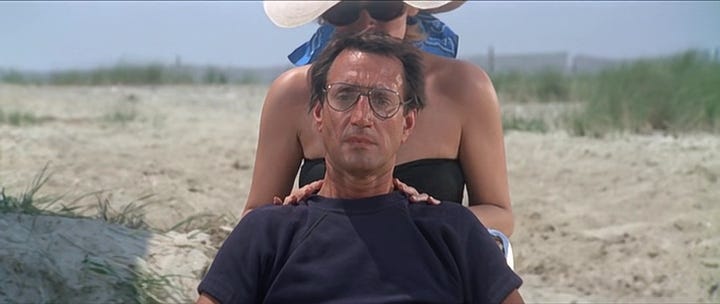
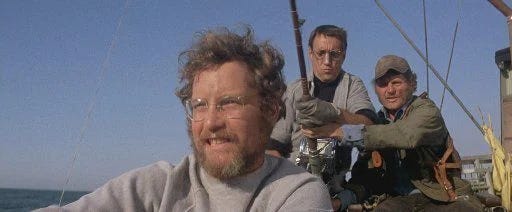
It has solid performances — not just in its trio of leads (Roy Scheider, Robert Shaw, and Richard Dreyfuss) — but in all its supporting players; Murray Hamilton is perhaps most obvious (his Mayor Vaughn is not merely a pro-business blowhard, there’s tortured pathos to his political scheming), but it is Lee Fierro’s portrayal of Mrs. Kintner (and specifically the scene where she runs into the water to discover it was her child who died) that is devastating in its raw simplicity.
It has a spare and epochal score courtesy of the ever-great John Williams, who took two solitary notes and turned them into an instantly recognizable theme.
And, of course, it is masterfully directed by the then only 26-year-old Steven Spielberg. It was just his second ever feature film, and yet he merged a creature feature concept with an Altmanesque naturalism that oozes atmosphere and heart and suspense.
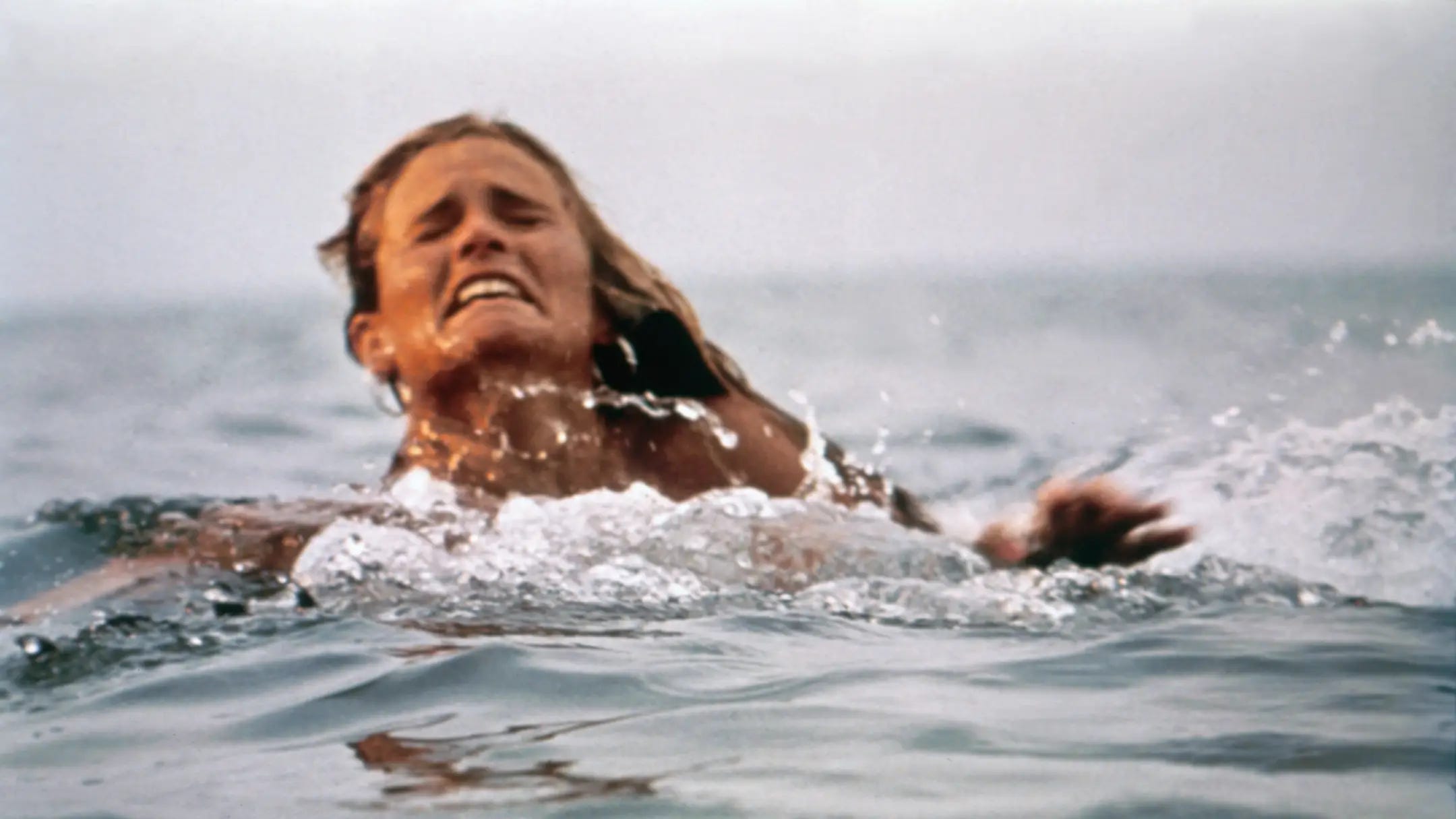
It is a film that far exceeds the sum of its parts — none of which were too shabby to begin with. There is a reason why, 50 years hence, we still regard Jaws as one of the greatest Hollywood movies of all time. Because it is.
Is Jaws a horror movie?
Of course! It is the film that made a generation afraid to swim in the ocean.
It has gory blood-drenched deaths, at least two standout jump scares, an existential threat that grows evermore terrorsome… and an unnerving and suspenseful undertow that runs beneath the entire film.
Aside from the political horrors that abound (keeping the deadly beach open to swimmers for the sake of profits — and the mayor here is still the mayor in Jaws 2, that’s why it’s important to vote in local elections, kids), it has at its core a very primal horror threat. Jaws is man versus beast. And not just any beast. A prehistoric monster with “lifeless eyes, black eyes, like a doll’s eyes…”
Let’s talk about the shark. It is well-documented that “Bruce” (the name given to the animatronic shark) malfunctioned to the point where original plans had to be scrapped, the crew had to pivot, and Spielberg concocted a solution that resulted in making the film far scarier than it would have been otherwise. So, for much of the film, you don’t see the shark.
It’s a lesson lost in the age of CGI-soaked big screen spectacles. The unassailable truth is the less you see, the creepier it is. Let the audience use their imagination; it’s free and it’s almost guaranteed to produce something far more intimidating than the special effects team can build.
It also makes the eventual reveal — inches away from Brody as he tosses chum into the sea — all the more jolting. The monster finally comes into the light. And whoa, he’s a big mother.
In Jaws’ case, finally seeing the shark it all its enormous glory has all the impact that you’d want. And it compounds the threat that already existed, ratcheting up the stakes as the film builds to a tension-fueled climax.
Fifty years later, Jaws continues to more than deserve its stellar reputation.
As an Amazon Associate I earn from qualifying purchases. You can support Horror Harwood by buying Jaws on Amazon here. Thank you :)