
Candyman (Bernard Rose, 1992)
Wait a minute, this guy is nothing like the ice-cream man...

Candyman is an interesting entry in the subgenre of horror that is the slasher movie. At its outset, the Candyman is pitched as a modern-day bogeyman with a hook for a hand. If you stand in front on the mirror and say his name five times, he will appear behind you and slice you from your groin to your gullet.
So maybe just don’t do that?
But this is not your average straight-forward spree killer splatter fest. It is a violent and disturbing film, to be sure — but this is “elevated horror,” before there was a term for it.

Candyman tells the story of graduate student Helen Lyle (Virginia Madsen, in a performance that surely inspired early seasons of The X-Files’ Dana Scully) who is investigating various urban legends and happens upon the local myth of the Candyman — a curious piece of urban folklore specific to the Cabrini-Green projects in Chicago.
But as Helen descends the rabbit hole of investigating the Candyman, she passes through the looking glass (literally!) until her own perception of reality and time is itself deranged. She finds herself in an apartment, covered in blood and with no memory of how she got there. She is restrained in hospital for what she thought was a single night, but was actually an entire month.
And worst of all, the Candyman now regularly appears to her. Taunting her to willingly become his victim. Demanding that she spill innocent blood in order to reaffirm the public’s belief in his myth.

Make no mistakes, Candyman is a movie about myths and the power that they have in our world. Candyman serves a purpose within the Cabrini-Green community. The sense of fear and of power he provokes are two sides of the same coin. The graffiti provoking his myth are but modern-day cave paintings preaching the gospel of his destruction.
Candyman deals with complex and overlapping issues of contemporary (and present) American society: racism, gentrification, and wealthy white liberals' fear of the black underclass.
There’s a definite throughline of the film that picks at the idea of both institutional and social bias.
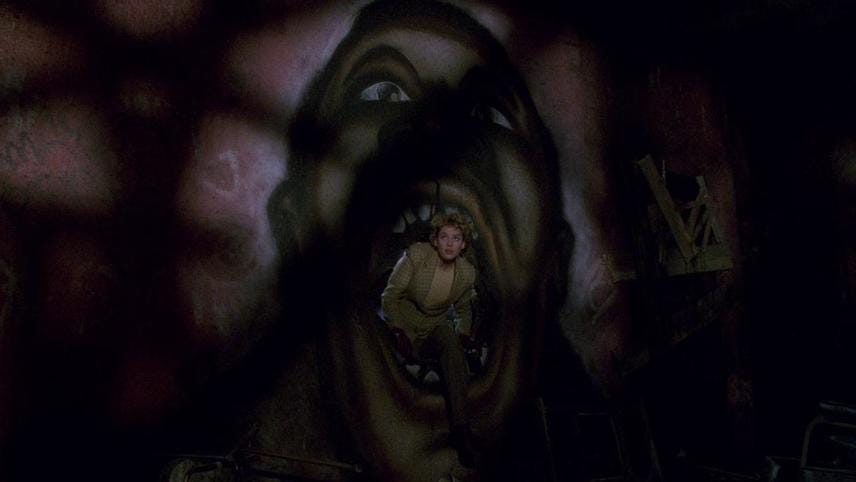
This is most prominent in the film’s depiction of Cabrini-Green as a gang-infested ghetto; one has to wonder how much of this portrayal is exaggeration, and — assuming it is — how much of that exaggeration is intentional versus unintentional-yet-willingly-adopted from a biased news media?
But it’s also addressed within Helen’s comfortable world. At a dinner with colleagues, an older, more-established male colleague scoffs at the young female academics trying to encroach on his turf. We the audience are guilty of it too: later on in the film Helen heads home and we catch ourselves thinking “well, of course, your husband is probably cheating on you with that younger student…”
The film itself has the polished sheen of a worthy, serious movie. The cinematography is impressive — from the opening overheads shots of Chicago to the raging bonfire of the finale. And the score by Philip Glass creeps and crawls under your skin as only the very best horror movie music can.
The same could be said for the entirety of this horror movie. Candyman will stay with you for long after the film has ended.
As an Amazon Associate I earn from qualifying purchases. You can support Horror Harwood by buying Candyman on Amazon here. Thank you :)